flytrap presents and documents projects and writing by Linda Carroli. This website instigated in January 2009.
::::::::::::::::::::
about
Linda Carroli is a writer, editor, researcher and consultant, investigating the areas of art, science, technology and urbanism. She is currently working on the Placing Project, an exploration of planning, community and environment, funded by the Visual Art Board of the Australia Council and hosted by Harbinger Consultants.
::::::::::::::::::::
find Email Facebook Twitter Flickr Linkedin::::::::::::::::::::
text
Critical Writing Electronic Works Urbanista Other Work
::::::::::::::::::::
projects
Harbinger Consultants works on a broad range of research, strategy and
vision projects designed to enhance creativity, futures and innovation
in communities, places and organisations.
::::::::::::::::::::
| Writing
ESSAY :: Community Benefits Agreements: Grounding Equitable Development in Community Negotiation
October 2009
This essay discusses the emergence of Community Benefits Agreements (CBAs) in the USA with a view to considering their applicability to Australian urban development processes. The Equitable (or Responsible) Development movement has endeavoured to mitigate the impacts of urban development and gentrification on low income and disadvantaged communities. CBAs have enabled community coalitions to broker benefits for local communities and neighbourhoods. The essay considers the implications of this in the Australian development and planning system, proposing that the types of community benefits that are brokered through local authority and developer agreements do not have the same type of impact that those brokered through CBAs have had. A further consideration is that CBAs and stakeholder engagement is a core pillar of Corporate Social Responsibility, which is largely under-developed in the urban development industry. CBAs and Equitable Development presents an opportunity for developers to enhance their corporate reputations while also delivering real benefits for disadvantaged and low income communities ... more Writing
URBANISTA :: Slices of Time
Arts Hub, August 2009
The relationship between
representations of places and the places themselves is slippery and
evocative. They are locked in reference to each other, tokens of each
other. The art and culture of the city, as an archaeological
undertaking, always involves an unearthing: either an uncovering or a
flight. A representation is a rendering that is ordinarily removed or
taken away: an impression is elsewhere, perhaps resituated as a
painting in a collection, and a sound, even when recorded, is fleeting.
New stories of art, experience and the city can be sifted and lifted
out of the archive or collection ... more ::::::::::::::::::::
Writing
URBANISTA :: Design Labs for Urban Futures Arts Hub, June 2009
Design labs are providing Australian designers and artists with opportunities to collaboratively envision and conjure diverse urban futures. Such environments draw designers into a developmental environment to explore design as a means by which to address the challenges of urban living and life. This article looks at three examples of design labs engaging interdisciplinarity ... more
Writing
URBANISTA :: Boom! shake-shake-shake the room ... Arts Hub, March 2009
The arts has a push and pull relationship with urban development and land use, often clustering in unattractive or undesirable inner city areas for their
accessibility, flexibility and affordability. After a cultural ecology and economy seeds, others pay heed. It's not just the artists and bohemian feel that
are noteworthy, but also the social mix and street life. Others are also attracted to those places and eventually those cheaper properties become the focus
of speculation, desirable redevelopment and investment opportunities, ushered in under the banner of urban renewal or urban consolidation. Policy, property
and planning seem to conspire to reify this economic dynamic. Renewal isn’t benign. When I was involved in resident action groups, let's say 20 or so years
ago, urban renewal wasn't supported by progressive social and affordable housing initiatives or consideration of community or design dividends.
It was progress - everything stopped for it and everything was swept aside for it ... more :::::::::::::::::::: Writing
URBANISTA :: Sensing and Searching the City Arts Hub, January 2009
Shortly after attending the Urban Screens event at Federation Square, Melbourne, in October, I received a copy of Urban Informatics: The practice and promise of the real time city. Both the book and event present varied practices and research focused on the dynamics of the city’s media, cultural and information ecologies, particularly in relation to urban and public screens. As a handbook for research, Urban Informatics, edited by Dr Marcus Foth, Senior Research Fellow at the Institute for Creative Industries and Innovation at QUT, is an impressive collection of scholarly work grounded in the premise that cities are swarming with movement and networks and that the social and media ecology of our cities is never still. ‘Urban informatics’ is a field of inquiry that is inherently concerned with systems of collecting, retrieving, sharing and storing information about, in and through the city: it is concerned, in part, with the mediation of urban life. Urban Screens presented an artistic and conference program that considered the changing relationships between culture, the city and the screen – from the very small screens of mobile phones, iPod and other mobile devices to very large architecturally embedded public screens. This composite of ideas and experiments resoundingly reminds us that as our cities are changing so too are our experiences of them ... more :::::::::::::::::::: Project
The Placing Project A project funded by the Visual Art Board of the Australia Council
Placing
is an emerging body of cultural writing, projects and interrogation
that will transverse place, placemarking, place writing and writing
place. Theorist Jane Rendell engages the idea of site writing,
interleaving the word with site and architecture. In much the same way
that Wordings considered, through various situations and encounters,
practices of words, Placing considers practices of place. However,
placing is not only about practices of place but also about practices
of writing place. Like writing, 'wording' and drawing, it is intended
as a both a noun and a verb – a thing and an action. Also like
'wording', placing is something we are often precise or careful about.
To place something carelessly or thoughtlessly (even a word) is to
misplace it or displace something else. Then, can we speak of place
without considering position? Or … disposition? more :::::::::::::::::::: Writing
Premier of Queensland's New Media Art Awards Review for Eyeline, January 2009
There are times when it becomes apparent that typologies of convenience, such as ‘new media art’, become unserviceable and, indeed, mendacious. For years, if not decades, the term ‘new media art’ has been wrangled and wrestled with in international discussion lists, publications and conferences. Quietly resisted assimilation was witnessed when the Australia Council erased their program targeting new media art to focus their funding of ‘new’ and ‘emerging’ forms, tendencies and platforms on collaborative, research-driven and interdisciplinary practice.
When the Queensland Government initiated the first of its biennial $75,000 acquisitive awards for New Media Art at the Gallery of Modern Art (GOMA) last year, it was another sign that institutions are also at a loss about how to meaningfully negotiate the terminology. In that instance, we might hopefully anticipate that the institution would assume a task of casting some light across the semantic uncertainties that riddle this field of many fields and that it might help us cast off the strangeness of this art movement where the media and/or the art somehow ceases to be ‘new’. As such a grand gesture towards these practices, we might feasibly expect the Award to make a grand, even brave, statement about the problematic legacy of defining art by medium or technology ... more
:::::::::::::::::::: Writing
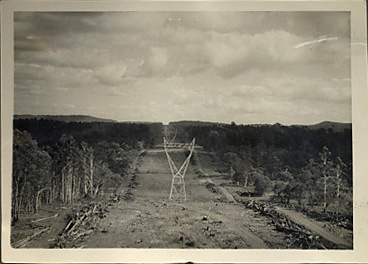
Transmission Lines 1955 - 1974  Transmission
Lines 1955 – 1974 is a project that documents my father’s working life
as a rigger and linesman with the Electric Power Transmission Pty Ltd.
This work is comprised of a number of content sharing and social
networking efforts to archive and present this story. My father,
Quinto Carroli, kept a photographic record of his working life and the
photographs featured in this map are his personal photographs from
various transmission line projects around Australia and Italy in the
period 1955 to 1974. His migration to Australia in 1956, to work on
electrification projects, was sponsored by the company.
Transmission
Lines 1955 – 1974 is a personal history that marks and documents space
and time. In compiling the information, I realised there were many
gaps, especially dates, and these gaps become part of the story by
provoking questions and assumptions. The postwar electrification
projects, powered predominantly by migrant labour, were essential for
building and modernising this nation ... more
::::::::::::::::::::
Writing
URBANISTA :: Move your body Arts Hub, March 2008 One
of the great and, as yet, unrealised promises of the digital age is
more leisure time and opportunities. High-tech and automated workplaces
and homes are supposed to save us time and money so that we can spend
less time working and more time playing, learning, relaxing and
participating. Recreation is supposed to be radically recreated. While
that promise was not born out and we disturbingly negotiate work/life
balance - pushed ever harder into longer work hours - we now have at
our fingertips different types of leisure spaces and opportunities.
Digital culture, new technologies, design and lifestyle have converged
to revive public spaces for recreation in the 21st century. Our cities
hum day and night and we are seeing the emergence of a participatory
public realm that slips between physical and virtual space, enabled by
wirelessness and mobility ... more
::::::::::::::::::::
Writing
URBANISTA :: Keeping it vital Arts Hub, February 2008 It was to turn into a day of strange serendipities evoking my distant
connections with Brisbane’s southside. I spilled into a gritty and
grungy West End as a student in 1983, just prior to the reclamation of
underused and predominantly industrial land in neighbouring South
Brisbane for Expo 88. There I lived for many years working across
creative fields like independent media, local history, the arts and
community development. West End was much loved by locals – by most
accounts it still is - with its street life, its ‘sense of community’
and its diversity – a mix of Indigenous, Vietnamese, Greek and Anglo
cultures. Alternative lifestyles also took hold, offering experiments
in commerce, consciousness and communitarianism. Students and artists
nested in like-minded share households while cultural organisations,
facilities and venues moved into disused warehouses peppered through
the industrial area along the riverbank. They staked out streets for
festivals or markets. The inner south offered choices, experiences,
proximity and inclusion ... more
::::::::::::::::::::
Writing Placemarking :: something happened here part of the Wording project, 2007
Many
private, state and city authorities have invested in public art
projects for decades with primarily permanent design and art works
dotted throughout new developments and city streets. As one colleague
recently said during her visit to Brisbane, observing the polished,
etched and cast forms embedded in the urban mesh, ‘all the public art
here is so shiny and new’. While this is one person’s observation
during a brief stay, perhaps it indicates that some urban environments
have reached a kind of tipping point where permanent and outdoor public
artwork is concerned. Its prevalence and proliferation is noteworthy as
a sequence of sites and works that might threaten to become, as Miwon
Kwon warns, ‘genericized into an undifferentiated serialization, one
place after another’ ... more ::::::::::::::::::::
|